NEWS: New Details Emerge from the Battlefield at Tollense
Last year archaeologists announced a fascinating find in the Tollense Valley in northern Germany. Approximately 3,200 years ago two groups of European warriors fought a battle in a marshy area near the Tollense Valley. It is the oldest known battleground in Europe. Archaeologists uncovered more than 140 bodies some with a wide variety of artifacts and weapons. The artifacts revealed that some of the warriors were wealthier and/or more powerful and better armed than others. Surprisingly, the bones of horses appeared in the find as well, probably belonging to the leaders on each side. All the bodies and artifacts are believed to have remained where they fell.

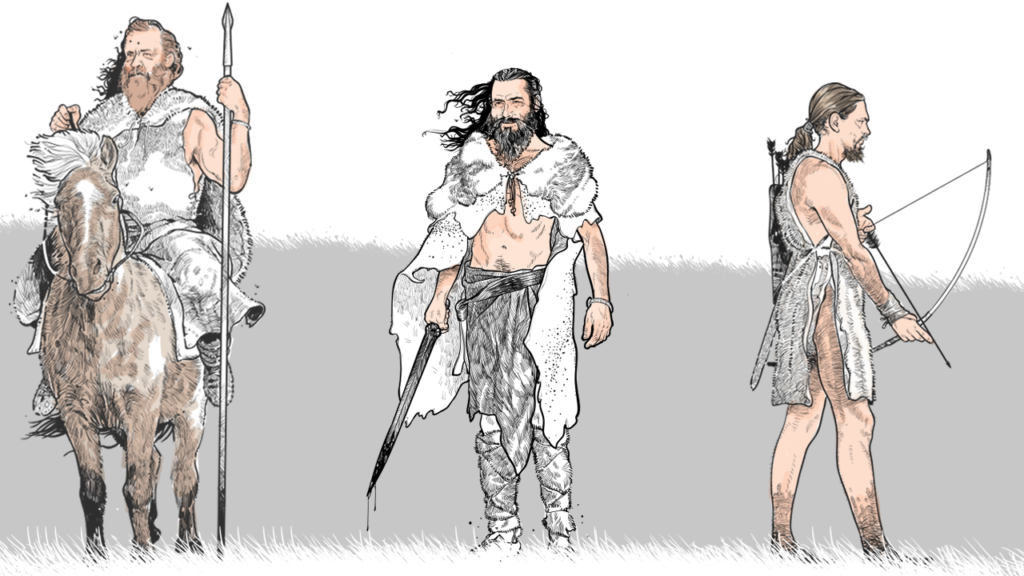
As scientists continue to investigate, more details are now coming to light. This latest article describes testing on the bones of the deceased warriors and examining some of the artifacts has revealed that many of the men were not from Northern Germany. Some may have come from hundreds of miles away. Several of the skeletons show previous traumatic wounds that had healed indicating they had fought in other battles. The array of weapons including wooden and metal clubs, stone and metal arrow/spear heads and even swords imply the soldiers trained in multiple weapon types meaning at least some of the warriors were not farmers who came out for an isolated battle but may have been full time soldiers or mercenaries.

In the time of this battle, Rameses II sat on the throne in Egypt fighting a war with the Hittites. The Assyrians were on the rise and the Shang Dynasty in China was enjoying a golden age. We know more about these cultures because they had writing and tended to use more permanent building materials like stone. Rameses, for example, helpfully left a large stone mural memorializing the Battle of Kadesh with the Hittites. European cultures have long been considered comparatively primitive and less sophisticated in this era.
New discoveries like the battleground at Tollense are generating a revised view. For example, the recently initiated and ongoing British Stonehenge Riverside Project has revealed that Stonehenge is not a freestanding monument but part of a much larger complex with wood and stone monuments spread all over the countryside. Evidence has emerged of monuments perhaps dating back to 7,000 BC, possibly doubling the age of the site.
The society that built the Stonehenge complex defies the traditional view of Bronze Age Europeans which the battleground at Tollense seems to confirm. Details such as stratification of the wealth and the presence of full-time soldiers and/or mercenaries point to significantly more developed cultures with sufficient surpluses to support them. Further, the artifacts recovered revealed European artisans possessed comparable skills to their Egyptian, Mesopotamian and Chinese counterparts. See the gallery of photos below:
It will be interesting to follow the developments of research and testing to learn more about Tollense and what it can tell us about a previously unknown history of Bronze Age Europe.
UPDATE 9/30/19:
Additional archaeological survey has uncovered the fact that a road cut through the battlefield. The marshy plain would have been difficult to traverse after heavy rains and during the wet season. As early as 1,900 BC (600 years before the battle), Neolithic builders laid down a causeway of wood, sand and turf, lined with stones that would allow year round travel. Remains of wooden pediments in the riverbed indicate a bridge of some sort spanned the river. Metal artifacts unrelated to the battle imply the region may have been an economic center of early Bronze Age production.
Research into the conditions circa 1,300 BC reveal the river was wider and more shallow, subject to fluctuating water levels. Aquatic plants lined the river as well. Many of the bodies were discovered in this swampy region and were likely submerged for an extended time. Sediment covered the bodies which prevented looting of the artifacts found with the bones.
I am attaching a link to the recent article:
https://www.livescience.com/60739-europe-oldest-battlefield-yields-secrets.html?utm_source=notification
Here is a link to another 2016 article with more detail on the underlying find and pictures of recovered artifacts:
http://www.sciencemag.org/news/2016/03/slaughter-bridge-uncovering-colossal-bronze-age-battle
Updated Sources:
Lidke, G. and Lorenz, S.: The Bronze Age battlefield in the Tollense Valley – conflict archaeology and Holocene landscape reconstruction, DEUQUA Spec. Pub., 2, 69–75, https://doi.org/10.5194/deuquasp-2-69-2019, 2019. https://www.deuqua-spec-pub.net/2/69/2019/
***Updated August 11, 2018 and September 30, 2019