
Khaled al-Asaad, Historian, Scholar and Defender of Civilization


Today is the birthday of Khaled al-Asaad (aka Khaled al-Assad). He was a remarkable Syrian archaeologist and scholar though many Americans and other westerners may not know who he was. In 2015, Al-Asaad found himself caught up in a horrific nightmare and in a dark moment displayed unflinching courage in the face of a great evil. Soldiers of the Islamic State of Iraq and Syria (ISIS) were advancing on al-Asaad’s home, the ancient city of Palmyra. Many fled, but Al-Asaad remained behind removing and/or hiding as many artifacts from the city’s museum as he could. His fears proved well founded. Shortly after ISIS captured the area, they began destroying ancient ruins with explosives and defacing inscriptions and statuary with sledgehammers. The invaders eventually seized and tortured the 82-year-old archaeologist trying to force him to reveal the location of hidden artifacts. When al-Assad refused to cooperate, his barbaric captors publicly beheaded him and hung his corpse from a street light with the labels “apostate” and “director of idolatry.” To ISIS, al-Assad was a criminal, but to us he should be remembered as a hero and a defender of civilization.
A Brief history of al-Asaad’s hometown Palmyra

Like many Middle East cities, Palmyra, Syria has ancient roots. Neolithic farmers built the first settlement which later became a Bronze Age town. First called Tadmor in the 18th century BC, perhaps a reference to the palm trees that surrounded the settlement. The city gradually grew in importance as part of many of the empires that crossed the Middle East including the Assyrians, Babylonians, Persians, Greeks and finally Rome. The Greeks gave Palmyra the name by which we know it today.

Palmyra emerged first as an oasis stop for caravans from Mesopotamia’s Euphrates River to Damascus and later as the terminus for the Silk Road for Mediterranean ports. Stone reliefs and artifacts from the Phoenicians, Assyrians, Babylonians and Persians attest to the interaction of traders and empire builders. With the unification of east and west under the Roman Empire, Palmyra reached full flower as a trade conduit between the Mediterranean, Middle East, China and India. Even after centuries of conflict, Palmyra boasted some of the most intact Roman ruins in the Middle East. The variety eastern and western traders generated a uniquely mixed culture. Local merchants and officials retained eastern religious practices but embraced Roman economic, political and funerary traditions.

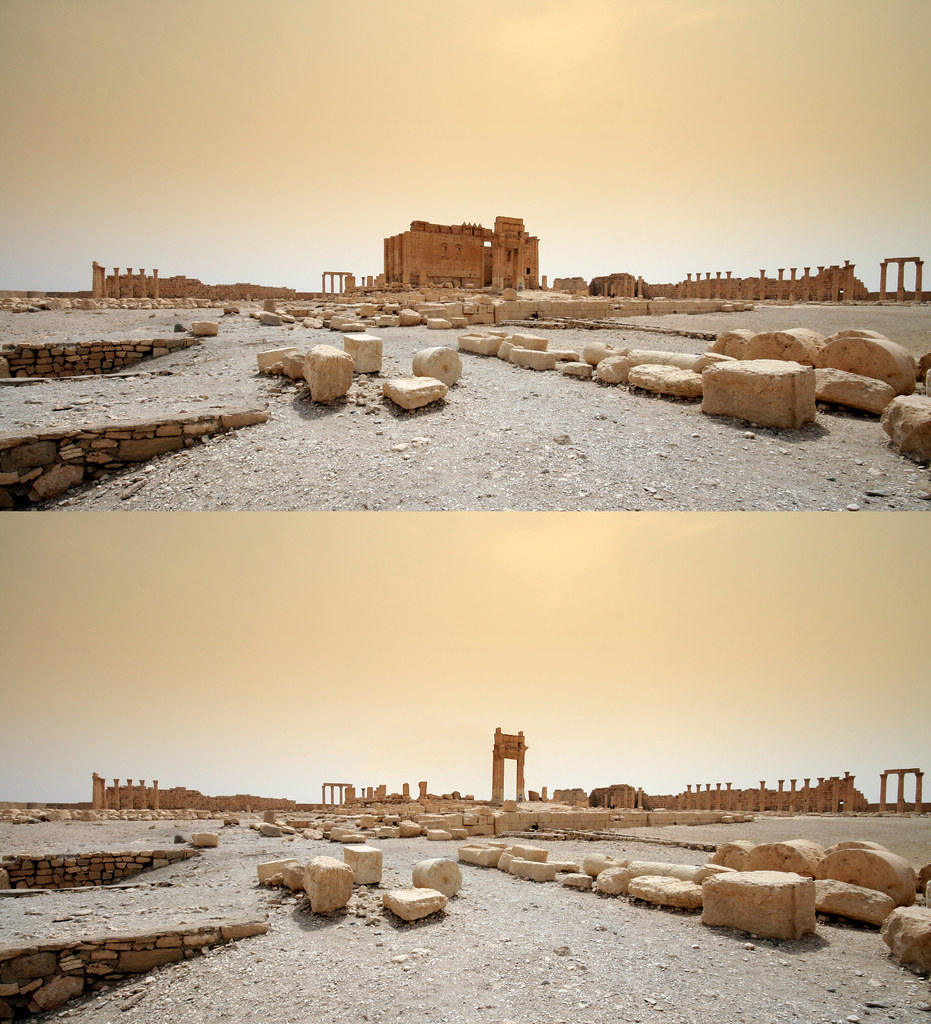
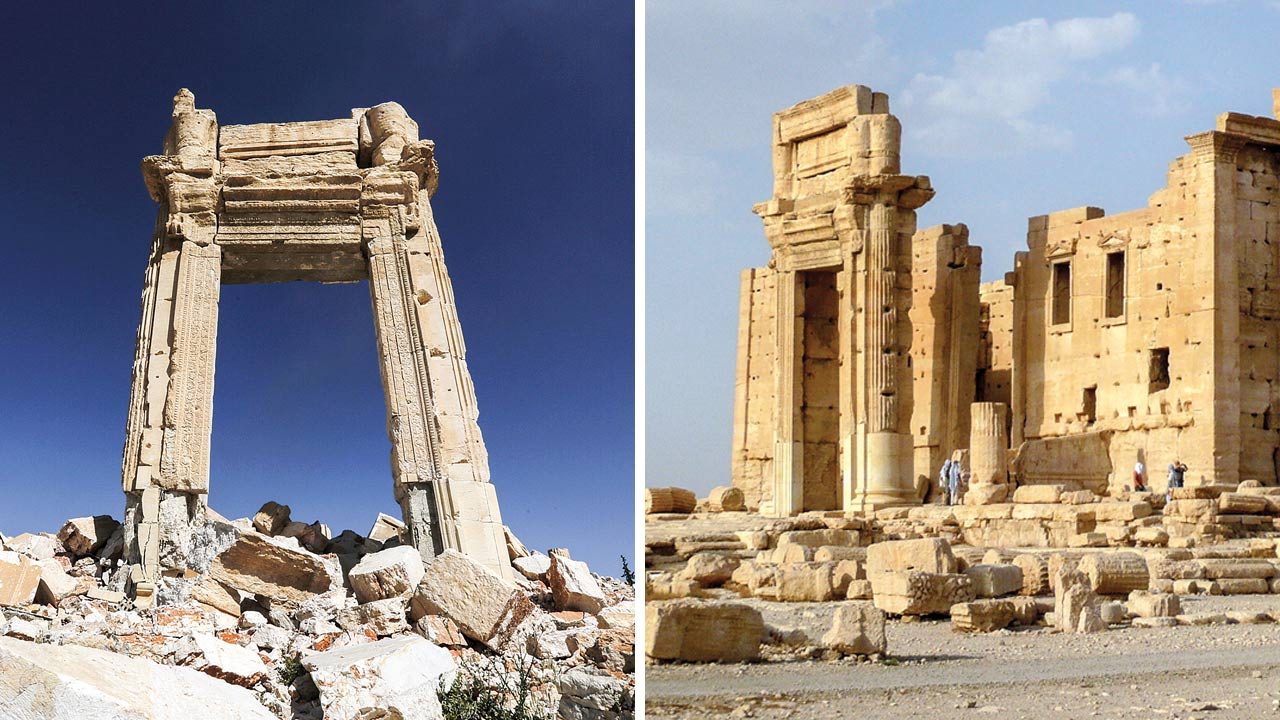
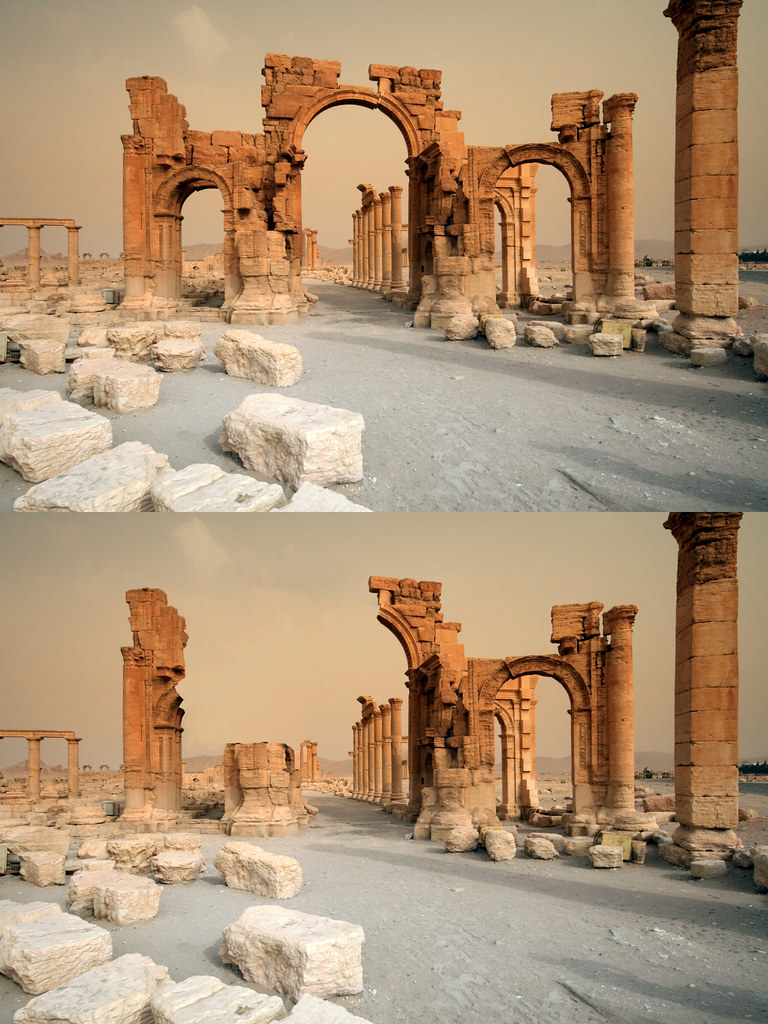
The Temple of Bel (also Baal or Temple of the Sun) constructed in 32 AD and rebuilt and re-dedicated over the centuries remained one of the best emblems of the ancient world as did the Roman colonnade from the 300s AD. Surviving tax and trade records provided a significant source of economic interaction amongst ancient merchants. Tombs often provide the most concentrated wealth of archaeological information and Palmyra’s crypts and graveyards became a vital resource: “These monuments provide us with some of the best evidence for jewelry in the Greco-Roman world. There are few cities in the Roman Empire that provide such an abundance of evidence for cultural change and negotiation.” [2]

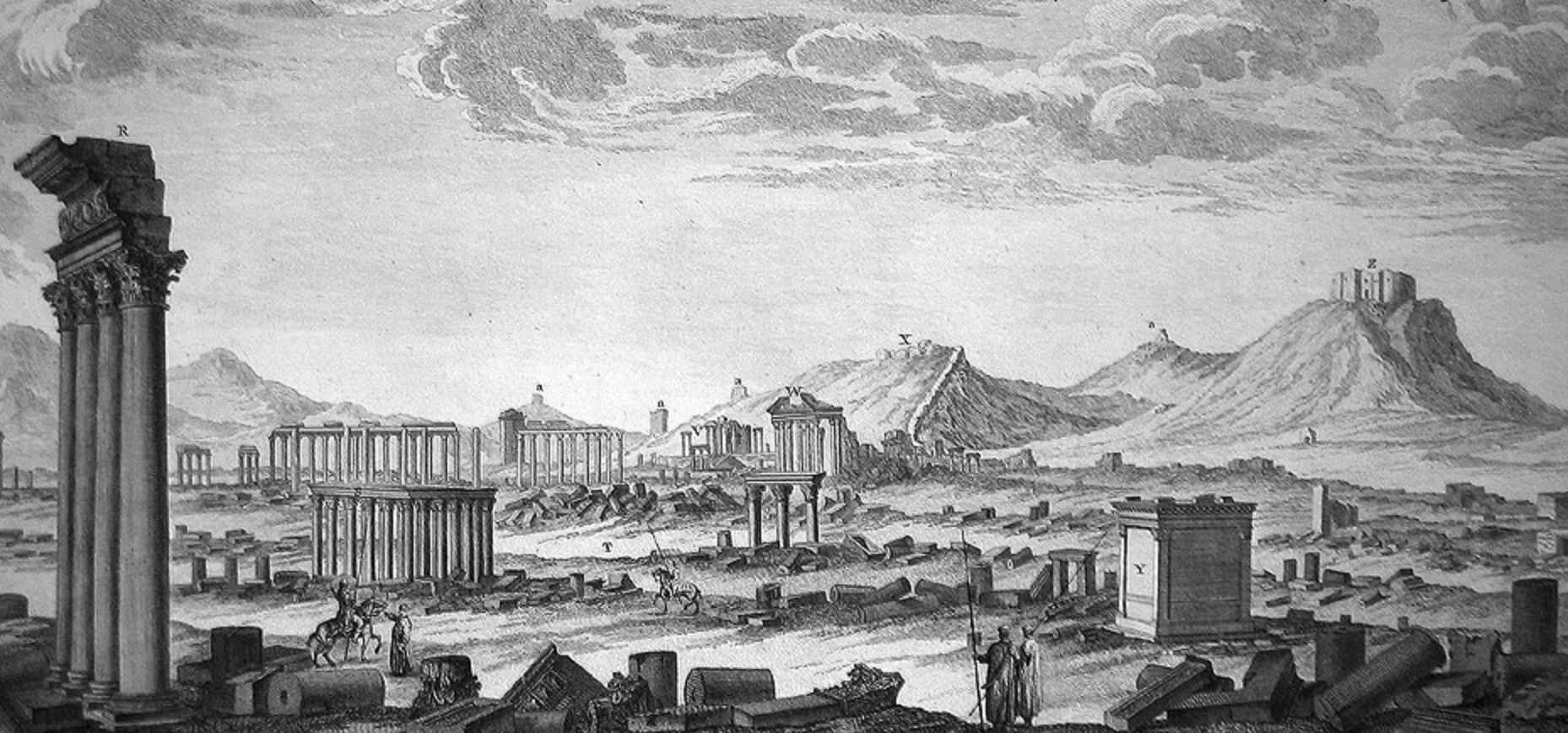
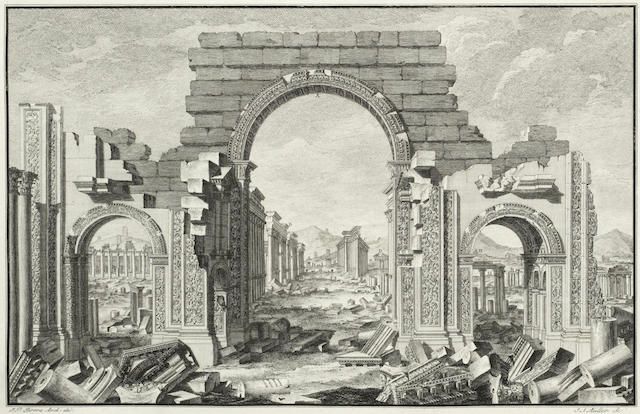
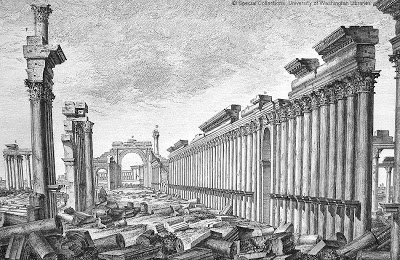
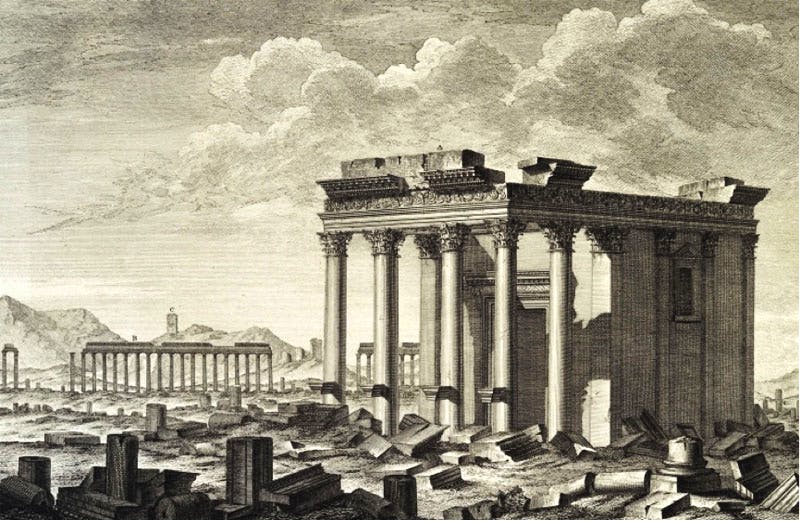
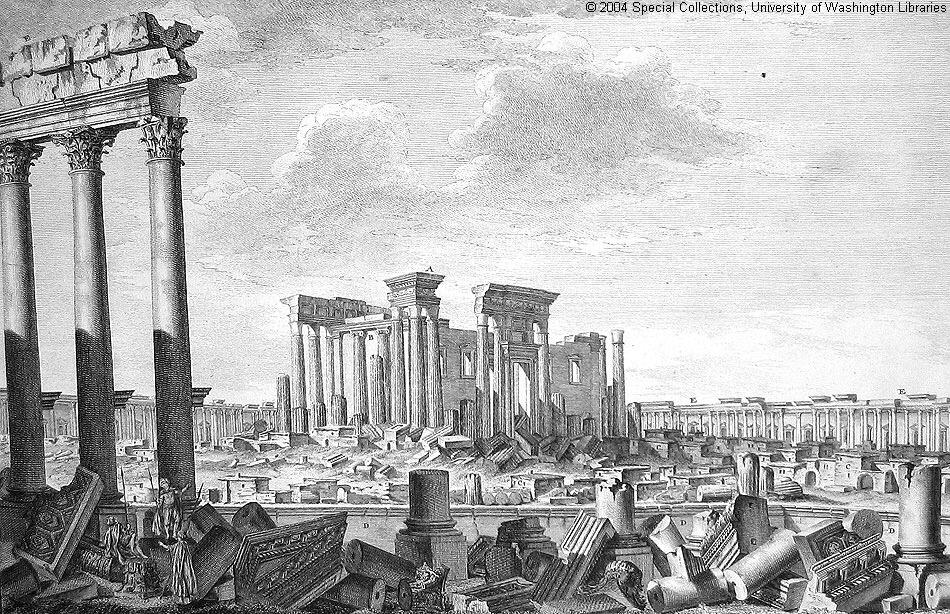
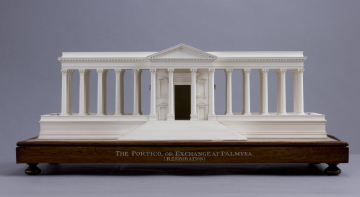
After Rome fell, the city became part of the Byzantine Empire and later the Islamic Umayyad Caliphate, but never recovered its glory as a Roman outpost. Though the ancient part fell into ruins, it still retained much evidence of thousands of years of cultures from east and west. Irish antiquarian Robert Wood re-discovered the site publishing The Ruins of Palmyra in 1757 complete with 57 drawings by Italian artist Giovanni Batista Borra. The book generated a sensation across Europe, especially in England, then in the midst of the Neo-Classical Era. Borra’s almost photographically accurate drawings influenced European and even American architects. Thomas Jefferson, for example, suggested the Portico of Diocletian as the model for the East Portico of the US Capitol.


Khaled al-Asaad and his Life’s Work
Khaled al-Asaad was born in modern Palmyra in 1932. Even as a youth, al-Asaad assisted archaeologists in their excavations, translations and interpretations of artifacts. He graduated from the University of Damascus with a degree in history receiving an appointment to direct several exhibitions at the museum in Damascus. As one of the few professionally trained Syrians, al-Asaad rose quickly becoming director of the newly founded museum in Palmyra in 1963. Believing that Palmyra held historic and worldwide importance, he opened the ruins to the public inviting American, European and Middle Eastern archaeologists to study the site. Al-Asaad directed excavations in a systematic and orderly fashion working hand in hand numerous international teams of academics to dig up artifacts, translate parchments and tablets and reconstruct the ruins of his home town. He was always careful to note subtle changes and nuances that reflected the convergence of multiple cultures to better understand their interaction.
As a result, Palmyra emerged as one of the most significant archaeological sites in the Middle East. Al-Asaad also learned Aramaic and other ancient languages becoming one of the foremost translators of ancient texts and inscriptions from Palmyra. He continued translating until 2011, long after his retirement in 2003. In keeping with his beliefs in the importance of the site, al-Asaad published many of his translations and interpretations in at least 20 papers and books. His writings greatly increased understanding of Palmyra’s place in the ancient world revealing much about the cultures that interacted there. 40 years of tireless and groundbreaking work paid off in 2004 with the elevation of Palmyra as a UNESCO World Heritage site.
ISIS Invades in 2015

One can only imagine the fears al-Asaad and other Palmyrenes must have confronted as ISIS forces approached in 2015. ISIS had already left a path of destruction demolishing the ruins at the ancient Assyrian capital Nimrud among other ancient sites. These barbarians would certainly destroy a lifetime of conservation work. Though 82, al-Asaad did not flee, he remained behind working feverishly to remove artifacts of the museum to Damascus.

Even after ISIS took full control of his home, al-Asaad remained trying to convince the terrorists of the value of the ruins and artifacts. It was to be in vain, ISIS fighters consider ancient statuary and depictions of ancient gods to be idolatry banned by their twisted and anachronistic interpretation of the Koran. They also saw the capture of artifacts as a means of making a profit. That which they did not destroy, they sold on the black market.
After three months of occupation, ISIS officials detained al-Asaad and tortured the 82 year old to ascertain where he had hidden artifacts they wanted to destroy or sell. When he refused their interrogations, ISIS took al-Asaad to a public square and beheaded him. They then displayed the body in a public crossroad with the aforementioned signs calling the scholar an “apostate” and “director of idolatry.”
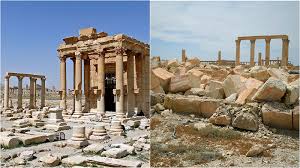
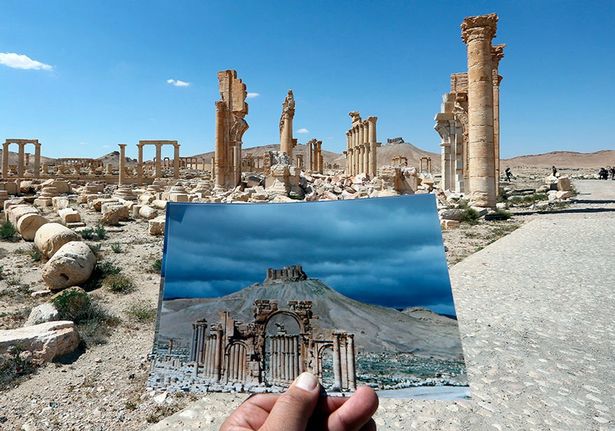
Syrian forces recaptured Palmyra in 2016 finding extensive damage caused by ISIS forces who dynamited prominent ruins and took sledgehammers to priceless statuary. They left thousands of mines and explosive boobytraps that had to be painstakingly removed.
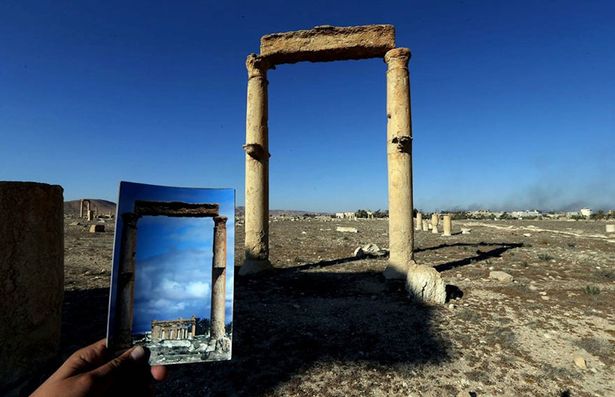
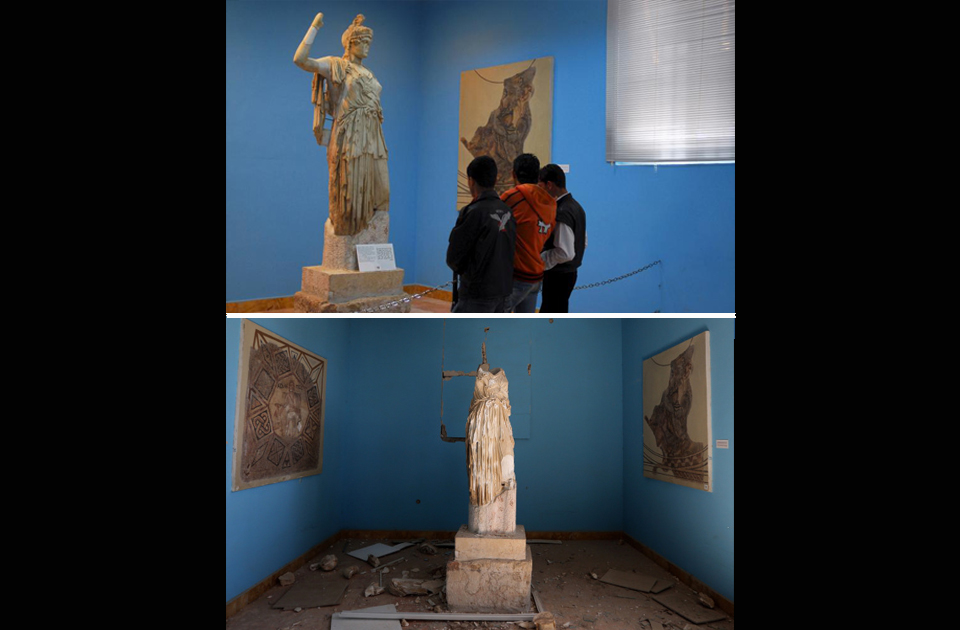
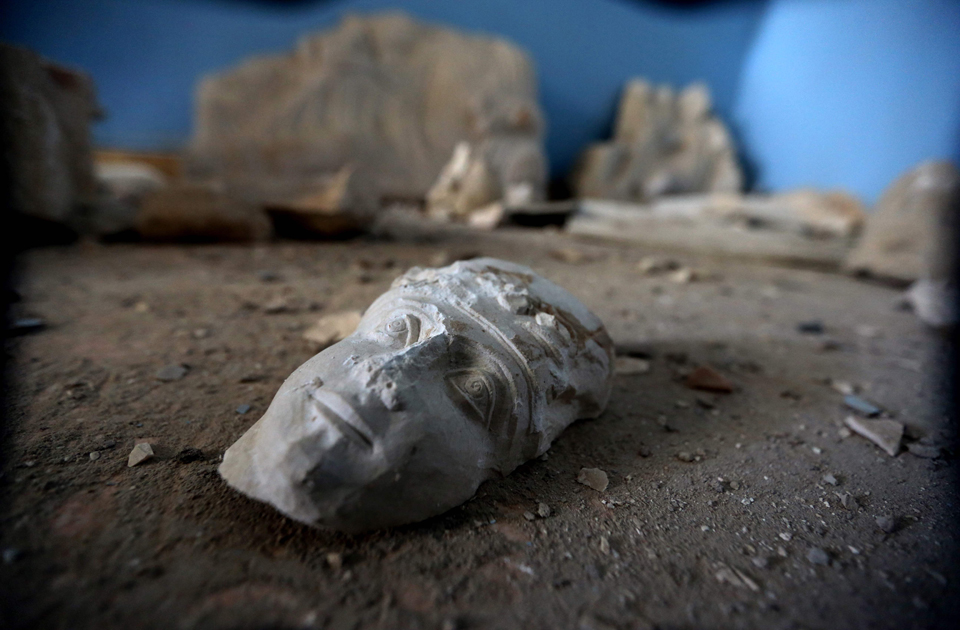
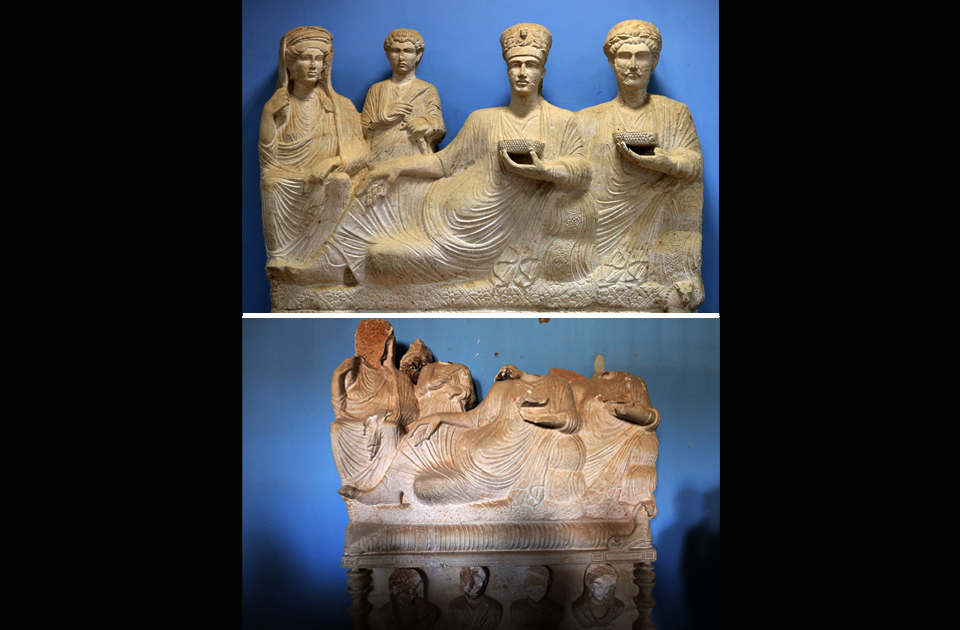
We must acknowledge ISIS for what it is, a fundamentalist Muslim faction bent on the very destruction of civilization in its misguided belief that all must kneel to its flawed and repressive theological worldview. However, it must also be remembered that ISIS does not represent most Muslims and indeed many who stand up to ISIS are Muslims including Khaled al-Asaad. He died gruesomely at the hands of a dangerous faction bent on tearing down human culture; an undeserved fate for scholar who dedicated his life to preserving history and culture.

The Syrian government and others have undertaken re-construction of those remains that could be salvaged though the damage was so extensive numerous ancient structures are lost forever. There was another cost that is harder to define and as difficult to replace. Prominent professor of Middle Eastern Studies at Shawnee State University Amr al-Azm , “You can’t write about Palmyra’s history or anything to do with Palmyrian work without mentioning Khaled Asaad.” [3] “Because [al-Asaad] spent so many years working on this site, he was so familiar with the archaeology of the area and the city, he was a huge repository of knowledge, all acquired first hand just by being there, and working it. And really this vast repository of information has now been lost to us. And it’s not the kind of information you can acquire by reading a book or attending a lecture, it’s all very practical knowledge and information. And it’s all gone now.” [4]

Despite the great loss at Palmyra at the hands of vicious and vulgar vandals, we should remember Khaled al-Asaad. In this dark moment we find a ray of light in his bravery and sacrifice in the face of repression and terror. He possessed some of the finest principles of humanity and the courage to risk his life for those rare and laudable beliefs. Al-Asaad gave his life to preserve monuments of our shared past. In doing so he made an enormous contribution to retaining our history as builders and artists which an evil faction like ISIS cannot diminish.


Above- The Lion of al-lat in 2010, after destruction by ISIS and then reconstructed. In spite of the extensive damage caused by ISIS, Palmyra can be partially recovered.
Footnotes:
[1] Jain, Raghav, Khaled al-Assad. Digital Encyclopedia of Archaeologists. https://msu-anthropology.github.io/deoa-ss16/al-assad/al-assad.html
[2] Romey, Kristen, Why Palmyra, Recently Liberated, Is a Historical Treasure. National Geographic, March 28, 2016. https://www.nationalgeographic.com/news/2016/03/160328-Palmyra-Syria-Islamic-State-ISIS-archaeology-Rome/ quoting Maura Heyn.
[3] Hassan Hassan, “Beheading of Khaled al-Asaad, keeper of Palmyra, unites Syria in condemnation.” The Guardian, August 22, 2015. https://www.theguardian.com/world/2015/aug/22/beheading-of-khaled-al-asaad-keeper-of-palmyra-unites-syria-in-condemnation
[4] Jain, Raghav, Khaled al-Assad. Digital Encyclopedia of Archaeologists. https://msu-anthropology.github.io/deoa-ss16/al-assad/al-assad.html
Sources:
Anonymous, “Model of the Ancient Portico of Diocletian at Palmyra. Sir John Soane’s Museum Collection Online.” http://collections.soane.org/object-mr23
Campion, Kristy. “Blast through the Past: Terrorist Attacks on Art and Antiquities as a Reconquest of the Modern Jihadi Identity.” Perspectives on Terrorism 11, no. 1 (2017): 26-39. www.jstor.org/stable/26297735.
Hassan Hassan, “Beheading of Khaled al-Asaad, keeper of Palmyra, unites Syria in condemnation.” The Guardian, August 22, 2015. https://www.theguardian.com/world/2015/aug/22/beheading-of-khaled-al-asaad-keeper-of-palmyra-unites-syria-in-condemnation
Jain, Raghav, Khaled al-Assad. Digital Encyclopedia of Archaeologists. https://msu-anthropology.github.io/deoa-ss16/al-assad/al-assad.html
Johnson, Daniel, “Why Palmyra Should Matter to the West”. Standpoint Magazine Online, Sept. 22, 2015. https://standpointmag.co.uk/issues/october-2015/features-october-2015-palmyra-daniel-johnson-should-matter-to-the-west/
McKrum, Kristie, “ISIS’ true assault on Palmyra revealed in heartbreaking before and after images of the ancient city” Irish Mirror, April 5, 2016. https://www.irishmirror.ie/news/world-news/isis-true-assault-palmyra-revealed-7693673
Romey, Kristen, “Why Palmyra, Recently Liberated, Is a Historical Treasure”. National Geographic, March 28, 2016. https://www.nationalgeographic.com/news/2016/03/160328-Palmyra-Syria-Islamic-State-ISIS-archaeology-Rome/
Another fantastic piece of history in our times. This archeologist should be honored by all peoples of all religions as a brave and godly man who gave his life so that our human history could be honored and cherished by future generations. With all the rewriting of our history by the propaganda of our times, the demolition of archaeological artifacts like in Palmyra, and the complete ignorance of our own country’s historical facts, I shudder to think of what our world will remember of us in the ions of history to come. Thanks for doing all this research and compiling… Read more »
[…] Khaled al-Asaad, Historian, Scholar and Defender of Civilization […]
I’ve been passionate about history since 4th grade, I don’t want to ever forget his name Khaled al-Asaad. A true hero.
Well said